Last year I wrote a blog asking the question every B2B marketer was quietly Googling (or, ironically, asking ChatGPT): Is SEO dead?
My answer then was nope, just dramatically evolving. I shared real Folloze data, some Schitt's Creek GIFs, and a framework for making your content the source AI systems actually cite.
A year later? I was right about the direction, but I underestimated the speed.
The shift from "where do we rank?" to "do we get cited?" isn't coming anymore. It's here. And I just lived through a real-world architecture decision at Folloze that taught me more about how this works in practice than any conference talk ever could.
So consider this the sequel. Less theory, more "here's what happened when we actually tested this stuff."
The Numbers Got Louder
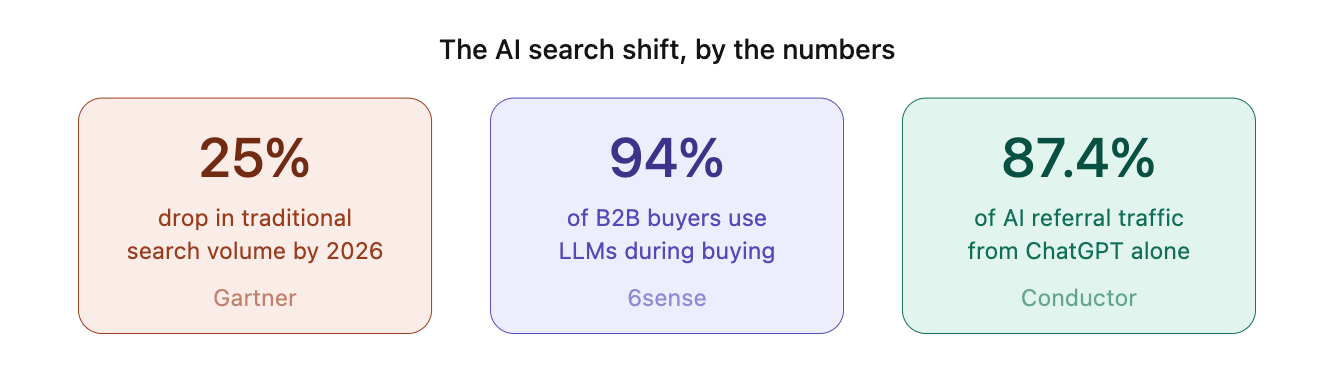
Let me update the data I shared last year, because the trends didn't slow down.
Gartner is now projecting a 25% drop in traditional search engine volume by the end of 2026 as AI chatbots and virtual agents absorb that traffic. According to a 6sense Buyer Experience Report, 94% of B2B buyers now use LLMs during their buying process. And Conductor's data shows ChatGPT alone drives 87.4% of all AI referral traffic to websites.
Samuel Schmitt, founder of thruuu, compiled SEO predictions from dozens of experts at the start of 2026 and the throughline was stark: Rand Fishkin predicts users will consume 10x more content via AI summaries than through actual articles by end of 2026. AI Overviews grew from 26.6% to 44.4% of queries, according to BrightEdge. As Samuel put it: "Your content is being consumed. Just not on your site."
Read those numbers together and the picture is clear: your buyers are still researching. They're just not clicking through to your website to do it. They're getting synthesized answers from AI, forming opinions about your brand, and building shortlists before they ever talk to your sales team.
At Folloze, our Q1 2026 data tells a version of this story. Sessions are down 80.9% year over year, but that's mostly because we intentionally pulled back paid social spend from $28K+ per month to about $800 while we rebuilt our entire targeting engine. The interesting part? Despite way less traffic, our engagement rate jumped from 30.9% to 42.0% and key events (the conversions that actually matter) are up 31.3%.
Less traffic. Better traffic. That's not a coincidence. That's what happens when the people finding you through AI-assisted research are more informed and more intentional by the time they arrive.
What a Year of Building an AI Visibility Practice Actually Looks Like
Before I get into the architecture decision, I want to share the full picture of what we've been building at Folloze, because the wins didn't come from one tactic. They came from layering multiple approaches over time and being honest about what wasn't working.
Where we started: In late 2024, I was manually tracking AI visibility across ChatGPT, Claude, Perplexity, and Gemini. Literally typing prompts into each tool, recording whether Folloze showed up, and tracking it in spreadsheets. I built an internal framework called GAME DAY (our AI visibility playbook) and a content methodology called C.I.T.E. (Contextual, Instructive, Trustworthy, Evergreen) to guide how we structured content for citation.
Where we are now: We run Promptwatch tracking across 92 prompts on folloze.com and 14 on our boards subdomain. We maintain an llms.txt file (now on version 6, 32.5KB) that serves as a machine-readable summary of our company, products, and key content for AI crawlers. We run a Noble mention program (5 strategic placements per month) to build our external citation footprint. We trimmed our SE Ranking keyword portfolio from 331 to 176 focused keywords after discovering that 124 had zero activity and 23 were completely off-topic for our ICP.
The wins we can point to:
Our ABX Guide ranks on page one for over 10 key terms and has become one of the most-cited resources when buyers ask AI tools about account-based experience strategies. That didn't happen because we gamed anything. It happened because we created the most comprehensive, well-structured resource on the topic, and we keep it updated.
ChatGPT mentions of Folloze increased from 1-2 per week to 5-8 per week over our tracking period. Our baseline Promptwatch data showed 40% brand visibility across four AI engines with 661 total brand mentions in 90 days, giving us a 39.6% citation share versus competitors. Those numbers gave us something we didn't have before: a benchmark to optimize against.
Our Storylane interactive demo became our top-performing content asset with 2,063 views, followed by the Panther partner case study at 1,087 views. Among Active and Surging accounts in Folloze and 6sense, we saw a +617.2% engagement lift. Content that was specific, interactive, and structured for extraction consistently outperformed generic pages.
We grew long-tail keyword rankings by 68% year over year by adopting topic cluster strategies over individual keyword targeting, using tools like thruuu for SERP analysis and keyword clustering.
The honest gaps:
Despite strong branded visibility, we had 0% organic (unbranded) visibility. That means when buyers asked about our category without naming Folloze, we were invisible. Competitors like TofuHQ (scoring 25), Userled (30), and Optimizely (35) were beating us on general category prompts. Our long persona-specific prompts (the "For a Chief GTM Officer who wants to..." variants) were all hovering at 0-6% visibility, which told us AI systems prefer shorter, more natural query phrasing.
We also discovered that content freshness has a dramatic impact: 30+ day old content gets 3.2x fewer citations from AI systems. That means your content calendar isn't just an SEO play anymore, it's an AI visibility play.
And then there was the technical infrastructure problem that nearly undermined everything.
What I Learned From Breaking (and Fixing) Our Own Board Architecture
Here's the part I didn't write about last year because I hadn't lived through it yet.
Folloze boards are content experiences. They're the destination pages we use for resources, customer stories, competitive comparisons, campaign landing pages, and pretty much everything a buyer touches before they talk to sales. How those boards connect to our website matters a lot for both traditional SEO and AI visibility.
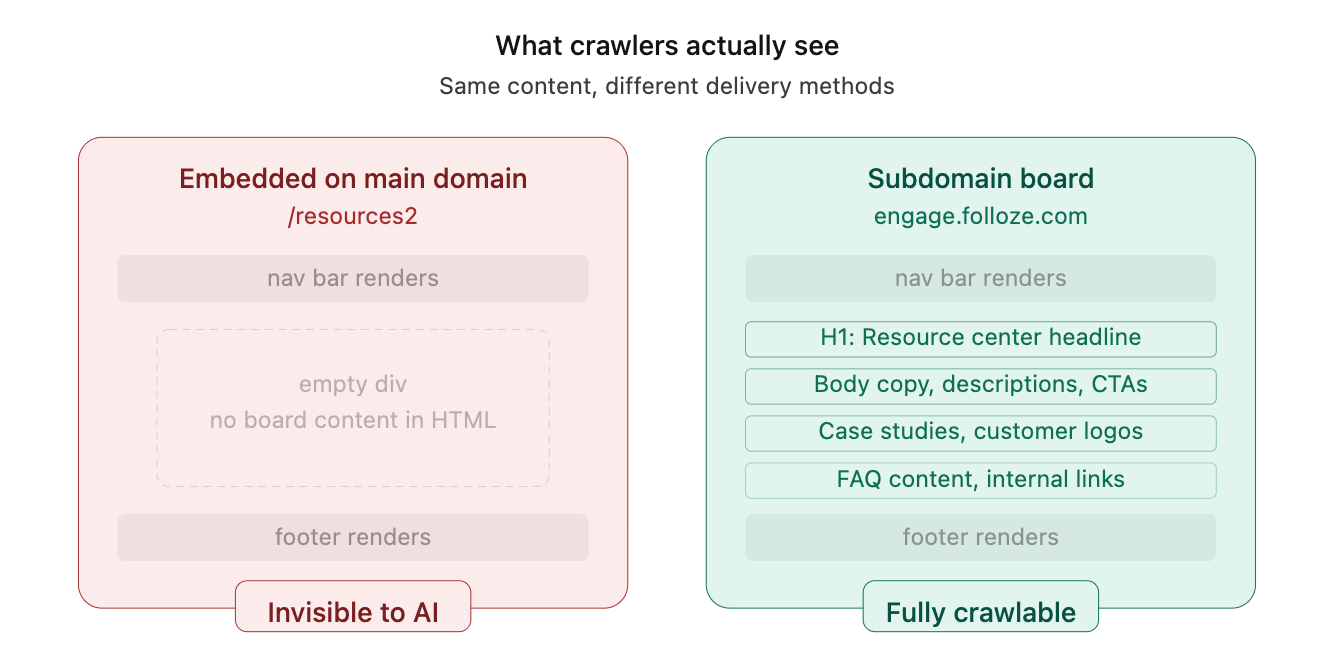
We had three options on the table:
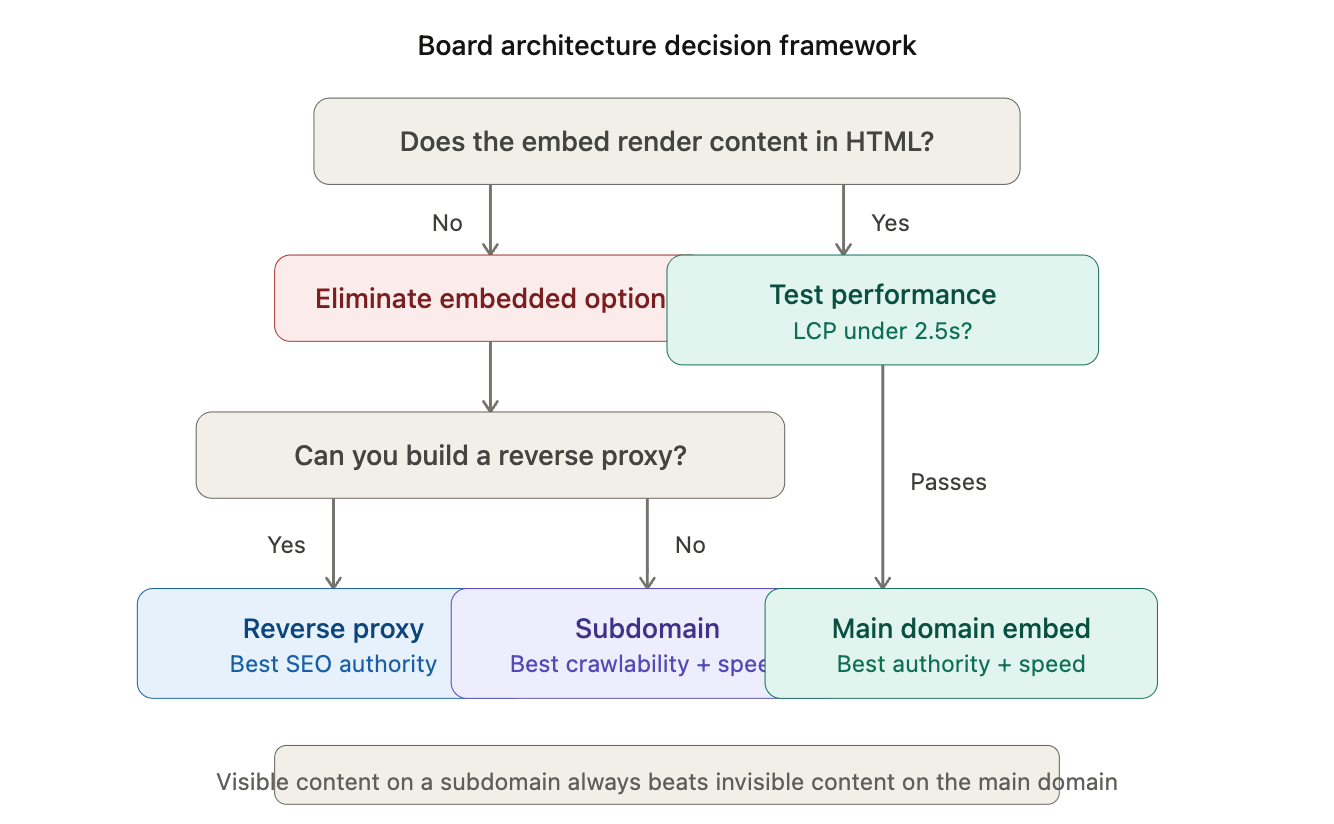
Option A: Embedded boards on the main domain. Theoretically the strongest for SEO because everything consolidates authority under folloze.com. Our product team built embedded versions of our resources and customers pages so we could move off a reverse proxy setup that was causing issues with Webflow.
Option B: Subdomain (engage.folloze.com). A separate branded subdomain where boards live on their own infrastructure.
Option C: Reverse proxy. Our original setup, where board content appears to live on folloze.com but is actually served from Folloze's infrastructure behind the scenes.
I did what any self-respecting digital marketer would do. I crawled all four pages myself.
And what I found made the decision for me.
The embedded versions (/resources2 and /customers2) returned empty pages. Not "kind of thin" pages. Empty. The Webflow shell rendered (nav, footer, page title), but zero board content appeared in the HTML. No case studies. No section headings. No body copy. No CTAs. Nothing a search engine or AI crawler could read.
The proxy versions? Full content. Every section, every customer story, every heading, all rendered and crawlable.
The engage.folloze.com boards? Also full content. I checked the existing Folloze vs. Mutiny comparison board and it returned rich HTML with titles, copy, comparison tables, customer quotes, and FAQ content.
So the "best SEO option" (embedded on the main domain) was actually the worst option, because crawlers couldn't see any of it.
This is the lesson I want every B2B marketer to internalize: an invisible page on your main domain is always worse than a visible page on a subdomain. The theoretical SEO advantage of consolidating authority means nothing if there's no content for search engines and AI systems to actually index.
We chose the subdomain.
Why Subdomains Aren't the SEO Boogeyman They Used to Be
I'll be honest, my initial instinct was to fight for the main domain. Every SEO playbook I've read for the past decade says subfolders beat subdomains for authority consolidation. And that's still generally true for traditional SEO.
But the landscape has shifted in two important ways.
First, Google's own guidance says they treat subdomains and subfolders equally. Now, SEO practitioners (myself included) have seen enough case studies to know that subfolders tend to perform better in practice, largely because link equity flows more naturally within a single domain. Sites that migrate from subdomains to subfolders often see organic traffic lifts. The reverse almost never happens.
But "generally better" and "always better" are different statements. When the subfolder option delivers zero crawlable content, the math changes fast.
Second, and this is the bigger shift, AI systems genuinely do not care about your URL structure. LLMs don't rank pages in a list. They synthesize information from across the web, evaluate entity consistency, assess content clarity, and decide what to cite. Whether your content lives at folloze.com/resources or engage.folloze.com/resources is irrelevant to an AI system deciding whether to mention Folloze when a buyer asks "what's the best AI orchestration platform for B2B campaigns?"
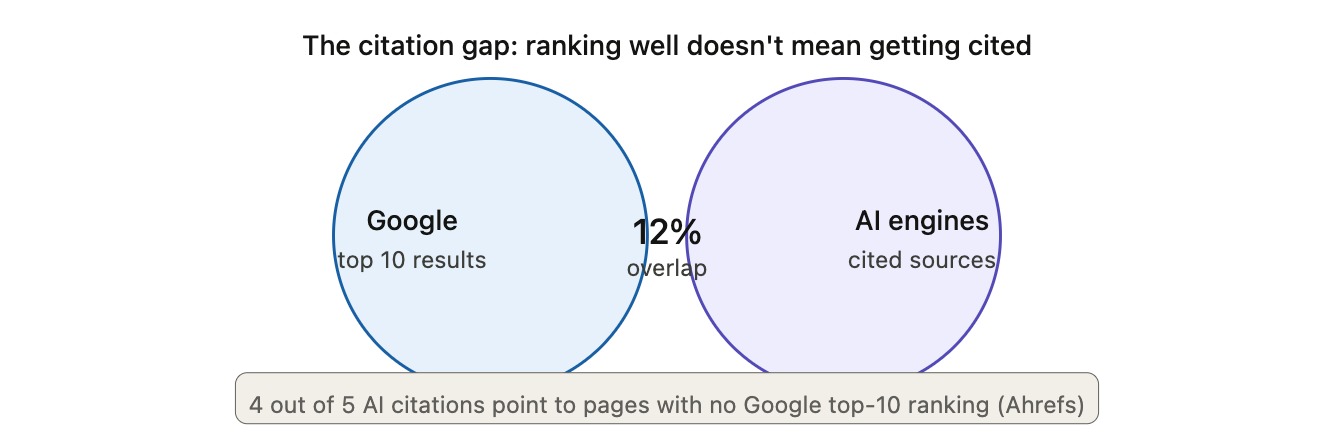
Here's a stat that hammers this home: Ahrefs studied 15,000 long-tail queries and found that only 12% of the links cited by ChatGPT, Gemini, and Copilot overlapped with Google's top 10 results for the same prompts. Four out of five citations pointed to pages that had no ranking presence at all. Research from GEO firm Brandlight suggests that the overlap between top Google links and AI-cited sources has dropped from 70% to below 20%. The traditional SEO playbook and the AI citation playbook are diverging fast.
What AI systems do care about: Is the content crawlable and indexable? Does it use consistent brand and product terminology? Is it descriptive, specific, and factually citable? Is it corroborated by authoritative third-party mentions?
None of those signals depend on whether your URL has a subdomain prefix.
The New Visibility Stack: SEO + GEO + Entity Authority
In last year's blog, I talked about making your content "AI-friendly and citation-worthy." This year I want to get more specific about what that actually looks like operationally, because I've been building it at Folloze.
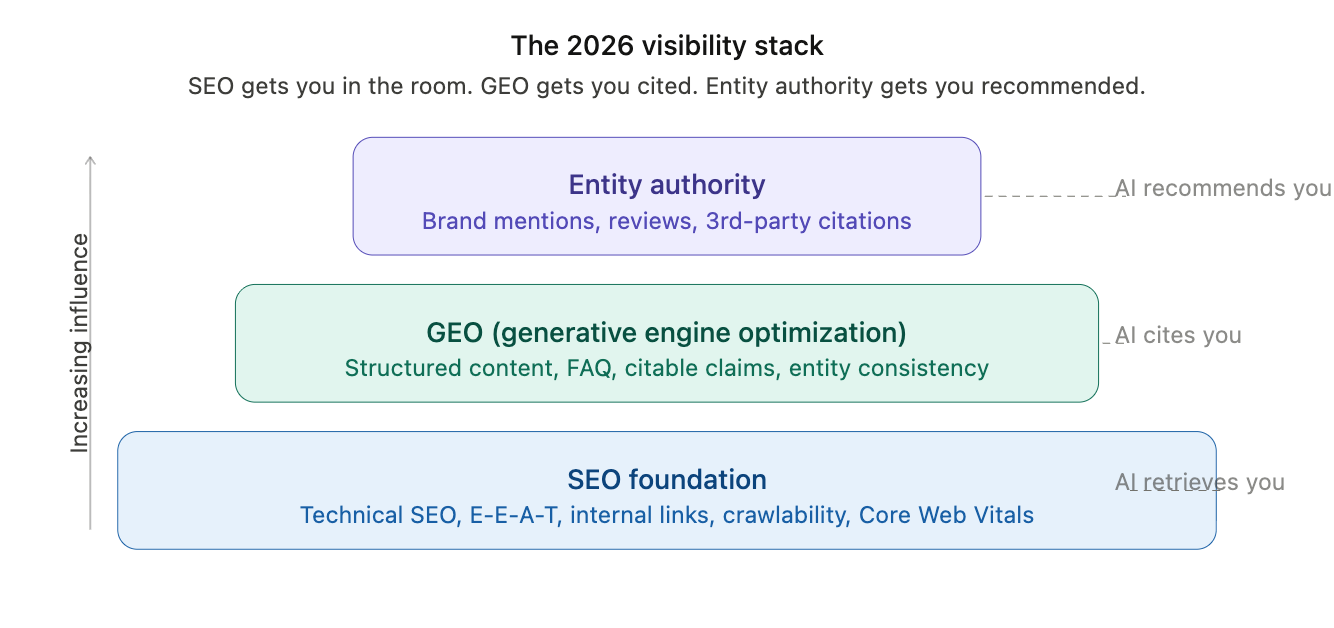
GEO (Generative Engine Optimization) is now a real discipline, not a buzzword. The term comes from a 2023 research paper out of Princeton and Georgia Tech, and it describes exactly what we're doing: structuring content so that large language models retrieve, cite, and recommend your brand.
Mike King, founder of iPullRank and one of the sharpest minds in this space, draws a critical distinction: traditional search is primarily a referral traffic channel, while AI search serves as a branding channel because of how little traffic it sends to your actual site. His concept of "Relevance Engineering" reframes the entire optimization challenge: you're no longer ranking pages, you're engineering content so retrieval systems can find it, recognize it as authoritative, and pass it to a generative model as part of the answer. iPullRank's AI Search Manual is the most comprehensive playbook I've found on this, and if you're a B2B marketer trying to understand the mechanics of how AI search actually works, start there.
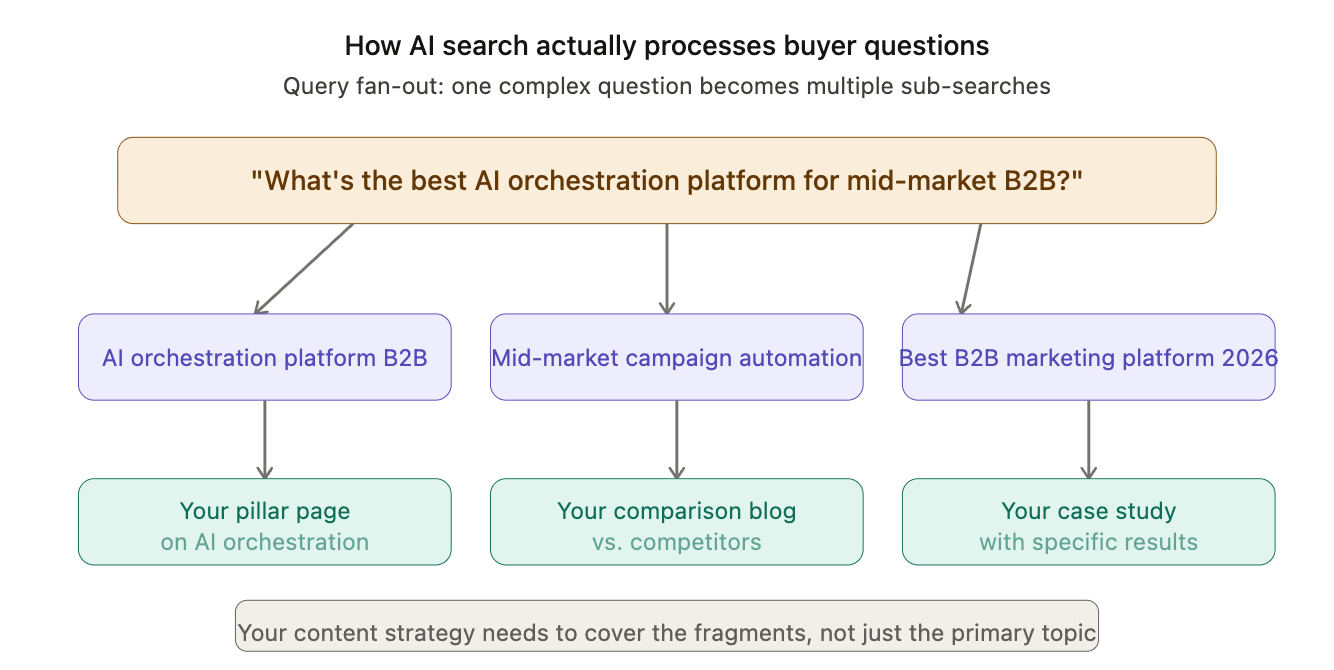
Mike also introduced the concept of "query fan-out," which is how AI search systems actually process questions. When a buyer asks ChatGPT something complex, the model doesn't search for the full question. It breaks it into multiple sub-queries and searches for each one separately. Garrett Sussman from iPullRank puts the practical implication simply: "Map the query fan-out. Identify the related questions, variations, and formats triggered by your top topics." This is why topic clusters and comprehensive content matter even more now than they did for traditional SEO.
Here's how we're approaching it:
Track What AI Systems Actually See
We use Promptwatch to monitor how Folloze shows up across ChatGPT, Perplexity, Claude, and Google AI Overviews. We track both branded prompts (where buyers ask about us by name) and unbranded prompts (where buyers ask about our category without naming anyone).
The unbranded prompts are the real battleground. Anyone can win a branded search. The question is whether AI recommends you when a buyer asks "what's the best platform for scaling personalized ABM campaigns?"
We found critical gaps. Folloze was scoring 10 out of 100 on "best digital sales room enterprise B2B" and 10 on "Folloze vs Userled" prompts. Those aren't just low scores, they're near-invisible.
For AI Overview monitoring specifically, thruuu's AIO tracking has become essential in our workflow. As Samuel Schmitt points out, AI Overviews now appear in roughly 21% of all Google searches depending on industry, and Google Search Console doesn't tell you when your brand appears in those AI summaries or which competitors claimed them. That gap is exactly what tools like thruuu, Conductor, and seoClarity are built to fill.
Madhav Mistry has been one of my go-to follows on LinkedIn for staying current on how AI search optimization is evolving in practice, especially for B2B use cases where the playbook is still being written. The community conversation happening across LinkedIn, Search Engine Journal, and AirOps is where the real practitioners are sharing what actually works versus what's just repackaged SEO with a GEO label on it.
Build Content That AI Systems Can Cite
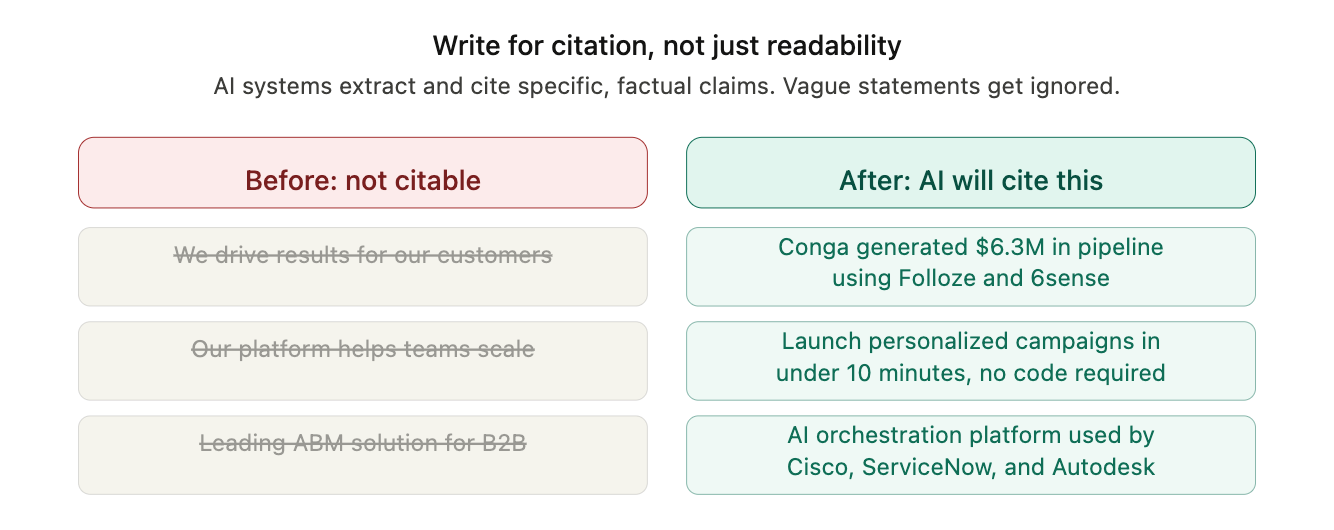
This isn't about keyword stuffing. In fact, a Princeton study on GEO found that keyword stuffing was one of the lowest-performing tactics for AI visibility. What works is what the researchers call "citation authority" and "entity clarity."
In practice, that means every piece of content we publish follows these rules:
State facts with specifics, not vague claims. "Conga generated $6.3M in influenced pipeline using Folloze and 6sense" is citable. "We drive results for our customers" is not.
Use consistent terminology everywhere. We position as an "AI orchestration platform." Not a microsite builder. Not a buyer experience platform. Not an ABX tool (depending on the day). Consistency is how AI systems learn to associate your brand with a category. If you call the same thing three different names across your site, you're making it harder for AI to cite you accurately.
Optimize at the passage level, not just the page level. This is one of Mike King's key insights that changed how I think about content. AI systems don't evaluate whole pages the way Google's traditional algorithm does. They break documents into smaller chunks (iPullRank calls them "Fraggles," a term coined by Cindy Krum) and decide which fragments to stitch into a response. That means every section of your page needs to stand on its own as a clear, citable passage. A brilliant opening paragraph followed by three vague sections means the AI only has one usable chunk to work with.
Structure content for extraction. Clear headings that match how buyers ask questions. Concise definitions at the top of sections. Comparison tables with factual, verifiable claims. FAQ formats that directly answer the questions your buyers are asking AI. As Search Engine Journal recently covered in their GEO strategies piece, AI engines love structured formats because they make it easy to pull specific answers out of longer content.
Make claims that third parties can corroborate. AI systems weight external mentions heavily. A claim on your own website is good. That same claim repeated on G2, in a customer case study, in an analyst report, and on a partner page is what moves the needle. One industry source estimates that roughly 250 documents across the web are needed to meaningfully influence how an LLM perceives a brand. SEO PowerPlays has been a great resource for understanding the practical mechanics of how external mentions compound into AI trust signals.
Treat Your Competitive Content as an AI Visibility Play
This is something I didn't fully appreciate last year. Your competitor comparison content isn't just for buyers who find you through search. It's training data for AI systems forming opinions about your category.
We're building comparison boards and blog posts for Folloze vs. Mutiny, Folloze vs. Userled, and Folloze vs. Prismic. Plus a category piece called "Why Website Personalization Isn't ABX" that challenges the core premise of all three competitors without naming any of them.
That category piece is doing triple duty. It targets the buyer who's evaluating website personalization tools, it positions Folloze above the category rather than inside it, and it gives AI systems a clear, authoritative statement about why campaign orchestration and website personalization are fundamentally different things.
If you aren't publishing comparison content, AI systems are forming opinions about your competitive position based on what your competitors publish. And I can tell you from checking Prismic's "Best Folloze Alternatives" blog post, they are not describing you accurately.
Your Website Architecture Is an AI Visibility Decision
This brings it full circle to the board architecture decision I described above. Your website structure isn't just a technical SEO decision anymore. It's an AI visibility decision.
Here's the hierarchy of what matters:
Crawlability is non-negotiable. If AI systems can't read your content, you don't exist to them. Check your page source. If the content only renders after JavaScript executes and doesn't appear in the raw HTML, most crawlers (both search engine and AI) will miss it.
Content clarity beats URL structure. A well-written, clearly structured page on a subdomain will outperform a vague, poorly structured page on the main domain in AI citation every time.
Entity consistency across your entire web presence matters more than any single page. Your company name, product names, and category positioning should be identical across your website, boards, social profiles, review sites, partner pages, and help docs. AI systems are building an entity graph of your brand from every source they can find. Inconsistency creates ambiguity. Ambiguity means you don't get cited.
Cross-linking is your authority bridge. If your boards live on a subdomain, build bridges back to the main domain through navigation, contextual links in blog posts, and footer references. And link the other direction too. Every blog post, solution page, and partner page on your main domain should link to relevant boards. This tells both search engines and AI systems that your subdomain content is part of the same authoritative ecosystem.
The Practical Playbook (What to Actually Do This Quarter)
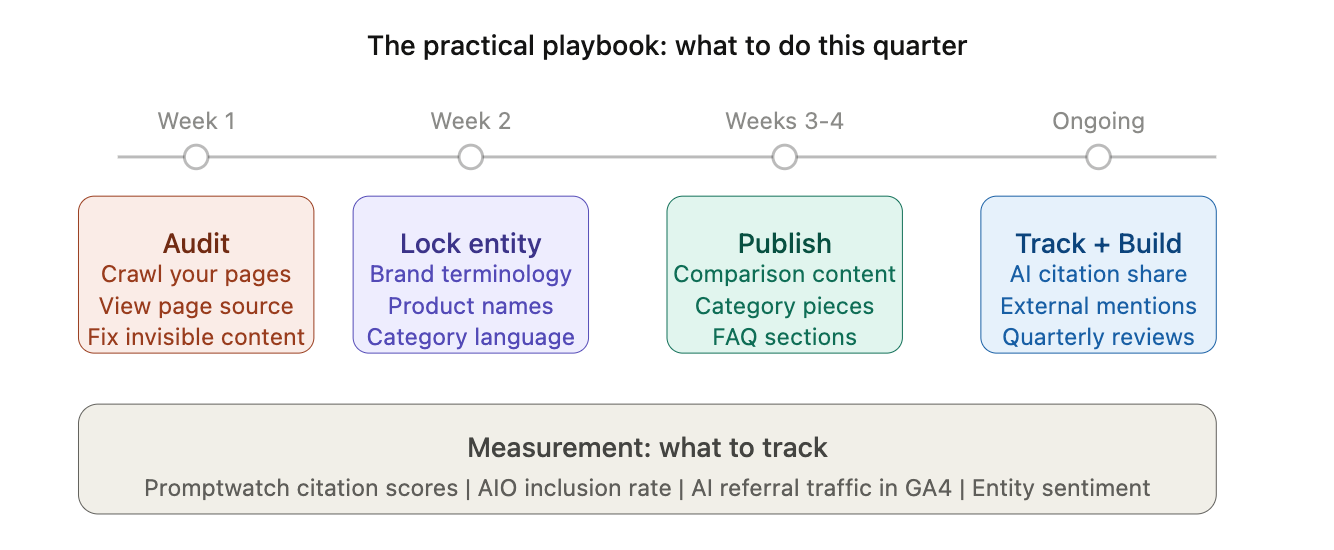
If I were starting from scratch, here's the order I'd tackle this in:
Week 1: Audit your crawlability. Fetch your most important pages the way a bot would (view source, not rendered page). If your content isn't in the HTML, fix that before anything else. No amount of optimization matters for pages AI can't read.
Week 2: Lock in your entity language. Document your official company name, product names, and category positioning. Make sure every page on your site, your boards, your social profiles, and your help docs use those exact terms. This is the single highest-leverage thing you can do for AI visibility.
Weeks 3-4: Publish comparison and category content. Answer the questions your buyers are asking AI. "What's the best [your category] for [your ICP]?" "How does [your product] compare to [competitor]?" "What's the difference between [your category] and [adjacent category]?" Structure these as clear, factual, citable resources.
Ongoing: Track your AI citation share. Tools like Promptwatch, thruuu's AIO Monitoring, Adobe LLM Optimizer, and Profound are emerging to fill this gap. Conductor's Academy has solid frameworks for building a tracking program from scratch, including their prompt tracking methodology that we use internally (75% unbranded, 25% branded prompt mix, tracked quarterly). Search Engine Land recently reported on a concept called "LLM perception drift," where AI brand rankings shift month to month as models retrain. That volatility means quarterly tracking isn't optional, it's how you catch problems before they cost you pipeline.
Ongoing: Build your external mention footprint. Publish on LinkedIn (Pulse articles can appear in AI search within hours). Get customer reviews on G2 and TrustRadius. Pursue strategic media placements and partner content. Each external mention is a vote of confidence that makes AI systems more likely to cite you. AirOps has been doing interesting work on automating parts of this workflow for B2B teams.
SEO Fundamentals Still Apply (The Experts All Agree)
I want to end where Google's own John Mueller landed at Google Search Live when asked about GEO and AEO: "AI systems rely on search. There is no such thing as GEO or AEO without doing SEO fundamentals."
He's right. And the people I trust most in this space are saying the same thing. Mike King frames it as building an "omni media content plan" that works across both traditional and generative surfaces. Samuel Schmitt at thruuu asks the right question in his SEO vs. GEO breakdown: "The brands that win in 2026 are the ones that stop asking 'SEO or GEO?' and start asking 'how do I optimize for both?'" Andreessen Horowitz published a major analysis of GEO calling it "Act II of search" and noting that the average LLM query is 23 words versus 4 for traditional search, with sessions lasting roughly 6 minutes. These users aren't browsing. They're delegating research to an AI. Your content needs to be trusted enough to be cited, not just ranked enough to be clicked.
The technical SEO basics I wrote about last year (mobile optimization, structured data, internal linking, E-E-A-T, Core Web Vitals) none of that stopped mattering. If anything, it matters more because AI systems use search infrastructure as part of their retrieval pipeline. RAG (Retrieval-Augmented Generation) means modern LLMs are querying search engines in real time before generating answers. Your SEO foundation is what gets you into the retrieval set that AI systems pull from.
The difference in 2026 is that SEO gets you into the room. GEO and entity authority determine whether AI introduces you as a recommended solution or as a footnote.
Last year I said SEO wasn't dead, just evolving. This year I'll say it's evolved. The marketers who are building for both traditional search and AI visibility, who are treating every page as a potential AI citation source, who are thinking about entity clarity as seriously as they think about keyword rankings, those are the ones whose brands will show up in the answer, not just in the search results.
Resources and People Who Are Shaping How I Think About This
I learn from a community, not just from experimenting alone. If you're a B2B marketer trying to build an AI visibility practice, these are the resources and voices I keep coming back to:
Tools I use: thruuu (SERP analysis and AIO monitoring), Promptwatch (AI citation tracking), Conductor (enterprise SEO + AI visibility frameworks), seoClarity (generative environment tracking), AirOps (AI-powered content workflows)
People worth following: Mike King at iPullRank (start with the AI Search Manual, then follow him on LinkedIn), Samuel Schmitt at thruuu (his SEO vs. GEO breakdown is required reading), Madhav Mistry (practical B2B AI search optimization on LinkedIn)
Publications: Search Engine Journal, Search Engine Land (their LLM perception drift coverage is excellent), SEO PowerPlays, and the Andreessen Horowitz GEO analysis for the big-picture strategic view.
---
Frequently Asked Questions
What is GEO (Generative Engine Optimization)?
GEO is the practice of structuring your content so that AI-powered search systems like ChatGPT, Perplexity, Google AI Overviews, and Claude retrieve, cite, and recommend your brand when buyers ask questions in your category. The term comes from a 2023 research paper by teams at Princeton University and Georgia Tech. Unlike traditional SEO, which focuses on ranking pages in a list of search results, GEO focuses on getting your content cited inside AI-generated answers.
Is SEO dead in 2026?
No. SEO is not dead, but it has expanded. Traditional SEO fundamentals like mobile optimization, structured data, internal linking, and E-E-A-T are still critical because modern AI systems use Retrieval-Augmented Generation (RAG), which queries search engines in real time before generating answers. Your SEO foundation is what gets your content into the retrieval set that AI systems pull from. The difference is that SEO now gets you into the room, while GEO and entity authority determine whether AI recommends you as a solution.
What is the difference between SEO and GEO?
SEO targets users who type short queries (averaging 4 words) into Google and scan a list of links. The goal is clicks and rankings. GEO targets users who ask full questions (averaging 23 words) to AI systems and expect a single synthesized answer. The goal is citations and brand mentions inside AI-generated responses. According to iPullRank's Mike King, traditional search is primarily a referral traffic channel, while AI search serves as a branding channel. The most effective approach in 2026 is to optimize for both simultaneously, since they share a common foundation.
Does my website URL structure (subdomain vs. subfolder) matter for AI visibility?
For traditional SEO, subfolders generally consolidate authority better than subdomains. For AI/LLM visibility, URL structure matters far less than content quality, crawlability, and entity consistency. AI systems care whether your content is indexable and descriptive, not whether your URL contains a subdomain prefix. An invisible page on your main domain is always worse than a visible, well-structured page on a subdomain. The most important factor is whether crawlers can actually read your content in the raw HTML.
How do I check if AI systems can read my content?
View your page source (right-click, "View Page Source" in most browsers) and look for your actual content in the HTML. If you only see an empty container, a JavaScript loading script, or a blank div where your content should be, crawlers cannot read it. Most AI crawlers and search engine bots do not execute JavaScript the way a browser does. If your content depends on JavaScript to render, it is likely invisible to AI systems. Also check your robots.txt file to confirm you have not blocked AI crawlers, and review CDN settings (Cloudflare recently changed defaults to block AI bots).
What tools can I use to track AI/LLM visibility?
The AI visibility tracking ecosystem is still emerging but maturing fast. Promptwatch tracks AI citation share across ChatGPT, Perplexity, Claude, and Google AI Overviews. Thruuu monitors AI Overview inclusion and helps identify which content formats appear in AI answers. Conductor provides enterprise-level AI visibility frameworks. Adobe LLM Optimizer tracks brand visibility across answer engines. For manual tracking, run 10 to 15 prompts your buyers would ask across ChatGPT, Perplexity, and Google AI Mode quarterly, and document where your brand appears versus competitors.
What is query fan-out and why does it matter for content strategy?
Query fan-out is the process AI search systems use to answer complex questions. Instead of searching for the full user question, the AI breaks it into multiple shorter sub-queries and searches for each one separately. For example, if a buyer asks "What is the best AI orchestration platform for mid-market B2B campaigns?" the AI might separately search for "AI orchestration platform B2B," "mid-market campaign automation," and "best B2B marketing platform 2026." This means your content strategy needs to cover not just primary topics but also the fragments and sub-questions AI systems generate when processing buyer queries. Topic clusters and comprehensive pillar content are more important than ever because of this mechanic.
How many external mentions does it take to influence how an LLM perceives a brand?
Industry estimates suggest approximately 250 documents across the web are needed to meaningfully influence how a large language model perceives and recommends a brand. This includes mentions on review platforms (G2, TrustRadius), industry publications, partner pages, customer case studies, social media posts (LinkedIn Pulse articles can appear in AI search within hours of publishing), and community forums. The key is building a consistent external footprint where your brand name, product names, and category positioning appear together across multiple authoritative sources.
Should I create competitor comparison content for AI visibility?
Yes. Competitor comparison content serves dual purpose for both traditional SEO and AI visibility. When buyers ask AI systems "How does [your product] compare to [competitor]?" the AI synthesizes answers from available sources. If your competitors have published comparison pages and you have not, AI systems will form opinions about your competitive position based entirely on what competitors say about you. Publishing factual, well-structured comparison content gives AI systems your perspective to include in those synthesized answers. Category-level content that challenges competitor positioning (without naming specific companies) can be even more powerful because it reframes how AI systems categorize your entire space.
And if you want the complete implementation framework for optimizing your Folloze boards for SEO and AI visibility, including the decision tree for subdomains vs. embedded vs. proxy, optimization checklists, and common mistakes to avoid, explore our Board Architecture Best Practices guide on engage.folloze.com. We built it as a Folloze board (not a PDF) because, well, the experience is the asset.
Because the worst thing you can do in 2026 is have great content that AI can't read.
---
Kristi Tutt is the ABM and Digital Marketing Manager at Folloze, where she runs LLM visibility strategy, paid media, content operations, and competitive positioning for a lean marketing team that punches way above its weight. When she wrote the first version of this blog a year ago, her title was Digital Marketing Specialist. Turns out, building an AI visibility practice from scratch while managing paid media, competitive content, and a full website rebuild is a pretty good way to earn a promotion. You can find her talking about AI visibility, ABX, and the occasional Schitt's Creek reference on LinkedIn.